Ambient Light
LED Light Strips for Bedrooms: Buying Notes
If you buy through links on this page we may earn a commission at no extra cost to you.
A bedroom LED strip lives or dies on two things the box never mentions: whether the adhesive still holds in month three, and whether the white setting is a real warm white or a blue-tinted impostor. The color effects are the easy part — every strip on the market can do them. Get the boring details right and a strip becomes the cheapest serious lighting upgrade in the room.
What we look for
Four criteria separate a strip you will still like next year from one you will rip off the wall by spring:
Warm white quality. Most strips handle saturated colors well and white badly. Look for tunable white (2700K to 6500K) or a dedicated warm-white chip, not RGB that fakes white by blending. Blended white runs greenish and cold, and it is why so many bedrooms end up looking like gaming setups.
Dimming floor. The strip should drop to a smooth 5 percent or lower without flicker. A strip that bottoms out at 15 percent cannot do the bedtime-glow job at all.
Adhesive and mounting hardware. The backing tape should be branded (3M or similar), and a kit that includes mounting clips earns immediate credit. Clips matter more than tape on any textured wall.
Cut points and extensions. Marked cut lines every few centimeters, plus a brand that sells extension segments, means the install can actually fit your wall instead of your wall fitting the strip.
Controller and app stability. The strip is only as good as the box that drives it. A controller that drops off the network, or an app that needs ten seconds to connect before every command, will sour you on the whole purchase. Reviews mentioning “stopped responding” within the first months are worth more than any feature list.
One criterion worth stating plainly: a bedroom strip does not need a microphone, a music-sync mode, or 16 million colors. Those features sell boxes, not sleep. The strips that earn a permanent place are the ones that nail the quiet settings and leave the fireworks in the app.
Adhesive is where cheap strips fail
The most common failure is not electrical — it is a strip sagging off the wall by February. Heat is the culprit: strips run warm, cheap adhesive softens, and gravity wins. Strips with branded adhesive survive; bargain-bin tape does not.
Honestly, even the good tape has limits. Fresh paint needs thirty days to cure before anything sticks to it, heavily textured walls need mechanical clips regardless, and anywhere the strip bends around a corner deserves a clip or a corner bracket. Treat the included clips as mandatory, not as spare parts, and the problem mostly disappears.
The second failure mode is heat trapped in enclosed runs. A strip sealed inside a narrow wooden channel or pressed flat against an unventilated shelf runs warmer than one in open air, and heat softens adhesive faster while slowly degrading the diodes. Leave breathing room above the strip, or use an aluminum channel — the extruded metal bar that strips snap into — which carries heat away and gives you a clean diffused line instead of visible dots.
White quality matters more than color modes
Here is the pattern we see over and over: buyers chase the strip with the flashiest app effects, then spend 90 percent of their actual evenings parked on warm white at 10 percent brightness. The party modes get old in a week; the warm setting is what you live with.
So prioritize the white spec over the effect count. A strip with a dedicated warm-white LED channel produces clean 2700K light that makes a bedroom feel like a hotel. A strip that only blends RGB to approximate white produces something slightly green and slightly gray, and no amount of app tweaking fixes it. If you want the full evaluation logic, our guide to lighting behind the bed walks through how the wall color and strip placement change what your eyes perceive.
Wall color shifts the math too. A strip washing a deep navy or charcoal wall needs more output than the same strip behind a cream wall, because dark surfaces swallow light — roughly double the lumens per meter for saturated dark colors. And a glossy wall behind the strip can mirror the individual LEDs instead of diffusing them; matte paint is the strip’s best friend.
Power, length and cutting
Strips come in 12V and 24V, and 24V handles longer runs with less brightness droop at the far end — anything over five meters should be 24V. Check the wattage per meter: 8 to 12 watts is typical for ambient use, while high-density strips near 20 watts per meter are overkill behind a headboard. Measure the run before buying, add 10 percent, and cut at the marked points. Plan the power supply location early, because the brick needs an outlet and a place to hide, and the strip’s dark tail running to it is the ugliest part of any install.
One more planning note: the power brick, not the strip, decides whether the install looks finished. Bricks sit warm to the touch and should never be buried under fabric or inside a closed drawer. Behind the headboard works if there is an outlet nearby; otherwise a cable raceway painted to match the wall hides the run for under ten dollars.
Three placements that earn their keep
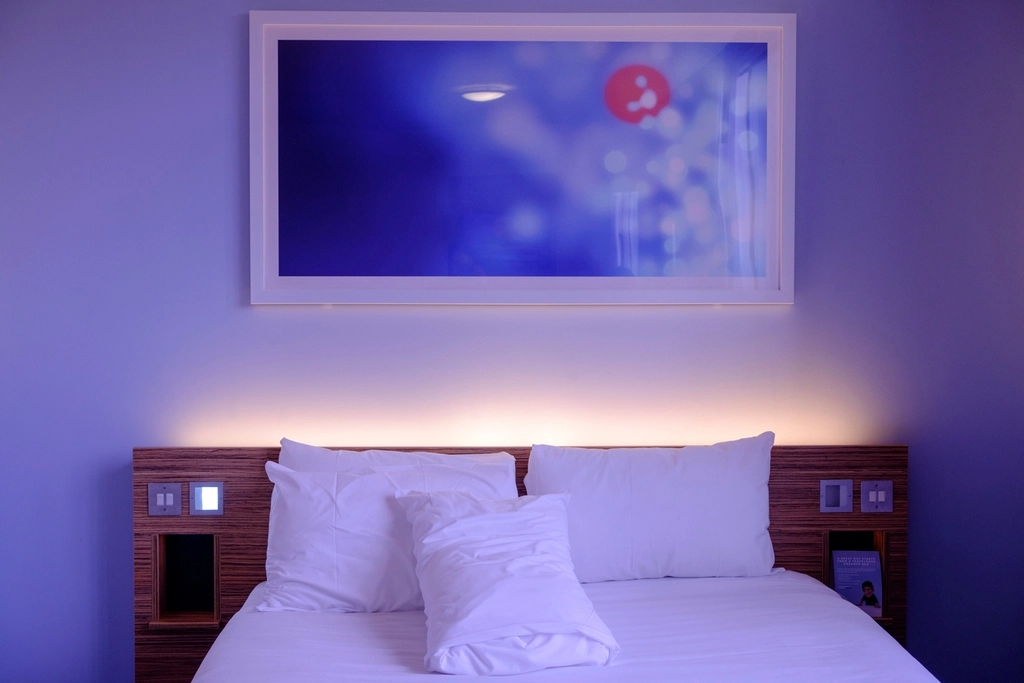
Behind the headboard, facing the wall, is the classic — soft indirect glow, zero glare, and it frees the nightstand. Under the bed frame is the underrated one: a toe-level glow that guides midnight trips without hitting your eyes. And behind a bedroom TV it doubles as bias lighting, which our TV backlight guide explains in detail. Every other placement is a variation of these three, and the full set of ambient-lighting ideas is worth a browse before you cut anything.
The picks
Tunable-white LED strip kit
Generic contemporary · $25-35 · Rated 4.6/5
The one to buy if you will actually use white light most evenings: dedicated warm-white channel, smooth dimming down to a candle-low floor, and clips included.
Best for: Bedrooms where warm white matters more than color effects
- Dedicated 2700K warm-white channel, not blended RGB
- Dims smoothly down to about 5 percent without flicker
- Branded adhesive plus mounting clips in the box
- Color effects are more basic than gaming-focused strips
- App wants an account before anything works
RGBIC addressable strip kit
Generic contemporary · $40-55 · Rated 4.3/5
The most fun you can have with a controller app, with segments that show different colors at once, if you accept a higher dimming floor and a colder fake white.
Best for: Rooms that lean decorative and get used after dark for more than sleep
- Addressable segments enable gradients and effects
- Schedules and music sync built into the app
- Marked cut points every few centimeters
- White mode is blended and runs cool
- Minimum dim level noticeably brighter than the top pick
Plug-in dimmable strip with remote
Generic contemporary · $15-22 · Rated 3.9/5
No app, no account, no fuss: a fixed warm strip with a handheld remote that just works, though the adhesive is the first thing you will replace.
Best for: Renters and anyone allergic to app setup
- Works in under a minute with zero setup
- Remote controls brightness in fine steps
- Genuinely warm fixed white, around 2700K
- Adhesive fails on anything but smooth surfaces
- No schedules or voice control at any price
| Model | Dimming floor | White quality | Adhesive | Control | Price |
|---|---|---|---|---|---|
| Tunable-white kit | About 5 percent | Tunable 2700-6500K | Branded tape plus clips | App and voice | $25-35 |
| RGBIC kit | About 12 percent | Blended white, runs cool | Branded tape, clips extra | App, voice, effects | $40-55 |
| Plug-in with remote | About 10 percent | Fixed warm 2700K | Basic tape, replace it | Handheld remote | $15-22 |
Frequently asked
- Can I cut an LED strip shorter?
- Almost all strips have marked cut points, usually every few centimeters, and cutting at those marks is safe. Cutting anywhere else severs the circuit and kills everything downstream. Measure the run first, then buy a length you can trim to fit.
- Why does my strip keep peeling off the wall?
- Textured walls, fresh paint and dusty surfaces defeat the adhesive on most strips. Wipe the surface with alcohol first, press for a full minute, and add a clip every foot or so. If the wall is heavily textured, clips are not optional.
- Do LED strips use a lot of power?
- A typical strip draws 8 to 12 watts per meter. A five-meter run behind a headboard costs a few dollars a year at average electricity prices, and dimming cuts that further. Power draw is not the reason to ration strip length.