Bedside Lamps
Where Should a Bedside Lamp Sit? Height and Distance
If you buy through links on this page we may earn a commission at no extra cost to you.
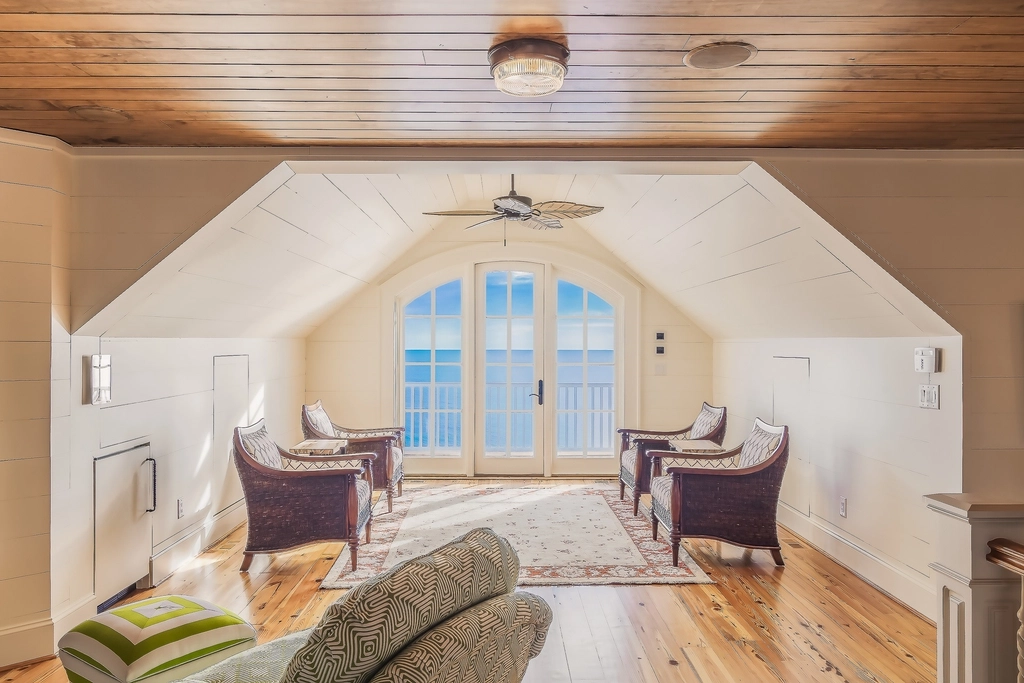
Two numbers settle most of the argument: the bottom edge of the shade should sit at eye level when you sit up in bed, and the lamp belongs roughly 18 to 24 inches from the edge of the mattress. Get those approximately right and almost any lamp behaves. Miss them and even an expensive one either glares straight into your eyes when you lie down, or strands the book in shadow while the wall behind it glows.
Eye level is the anchor
Sit up in bed the way you actually do at 10 p.m. — slouched, propped on two pillows, not showroom-straight — and notice where your eyes are. That height, measured above the nightstand surface, is where the bottom of the shade wants to live. For most beds and standard 24 to 28 inch nightstands, that puts the shade bottom 20 to 24 inches above the table top, which means a total lamp height somewhere around 24 to 28 inches.
The reason is glare geometry, not style. If the shade bottom sits below your seated eye level, you look down into the shade at the bulb. If it sits above, the glowing shade reads as a soft object in the upper field while the bulb stays hidden. A lamp that is too short can be rescued with a wooden riser under the base; a lamp that is too tall can only be fixed by swapping the shade for a deeper one or dropping to a lower bulb.
Adjust the anchor for how you actually sleep. Stomach and side sleepers prop themselves differently than back sleepers — propped high on two pillows, they sit with eyes 3 to 4 inches higher than the textbook pose, so err tall. If you read lying flat on your back with the book lifted, eye level drops to almost pillow height and no table lamp clears the sight line; that is a wall-mounted reading light problem, not a lamp-buying problem. And on an adjustable bed, measure at the position you actually read in, which is usually halfway reclined.
The distance that keeps the pillow dark
Distance works the same logic from the other direction. A lamp 18 to 24 inches from the mattress edge sits roughly above your shoulder when you lie down — outside the sight line of someone looking at the ceiling, and far enough sideways that spill lands on bedding rather than faces. Push the lamp back against the wall on a deep nightstand and the light has to cross your body to reach a book, which tempts you to crank brightness up until the whole room pays for it.
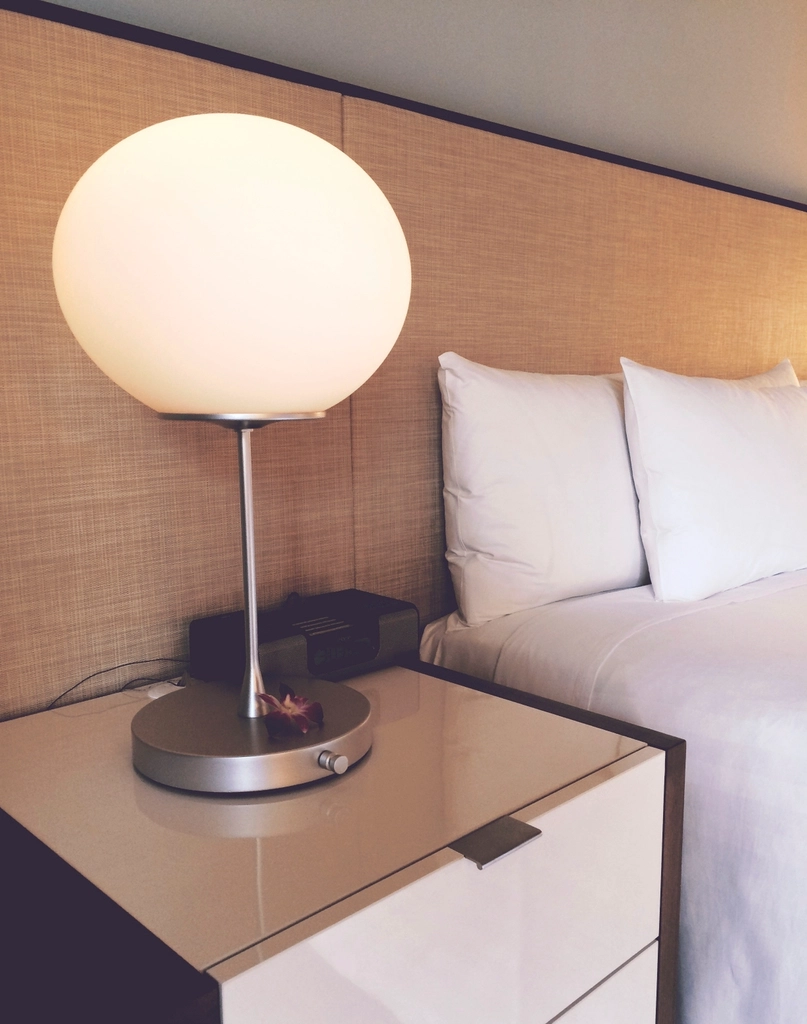
The second job of distance is reachability. The switch — whether it is on the cord, the base, or the shade — should be operable without sitting all the way up. If you have to stretch or stand to turn the lamp off, the lamp is too far away no matter how good the geometry looks.
Shared beds add one wrinkle: the lamp’s pool has to end before the other sleeper’s half. A lamp 20 inches from the mattress edge with a shade 14 inches wide throws light roughly a foot past the rim, which on a queen bed stops right around the middle. On a king, the same setup leaves the far half comfortably dark; on a twin pushed against a wall, the pool reaches the wall and bounces back, so drop the bulb output a step. Measure the throw by lying on the empty far side and looking for the shade’s edge glow — if you can see the brightest part of the shade from there, the lamp is too close to the border.
Fixing a lamp that is already wrong
Bought lamps rarely get returned over placement, so adjust what you have. Three moves cover most cases. One: raise a short lamp on a riser or a stack of books until the shade bottom clears seated eye level — cheap and invisible under a base. Two: swap a shallow shade for a deeper one 2 to 3 inches taller; the extra depth hides the bulb from lying-down angles and pushes more light downward. Three: drop the bulb 200 to 300 lumens and add a plug-in dimmer, because a dimmer at the wall lets you tune the glare out night by night.
Honestly, some rooms just do not have the geometry — a wide bed, a 14-inch nightstand pinned between it and a wall, a low headboard — and no amount of risers fixes that. When the numbers cannot work, stop forcing the table lamp.
One more constraint people forget until move-in day: the outlet. The right position is useless if the cord cannot reach it, and extension cords snaking across a walkway are a trip hazard in a dark room. Check where the outlet sits before buying — behind the nightstand, above the baseboard, or (in older rooms) on the opposite wall. A lamp with a 6-foot cord and a flat plug covers most placements; anything longer runs on a cord channel along the baseboard.
When to give up on the table lamp
A wall-mounted reading light solves placement by removing the surface constraint entirely: mounted at seated eye level, aimed at the pillow side, it cannot drift out of position the way a table lamp can. Renters can get there without drilling, and a swing arm adds aiming range for shared beds. A small pendant hung beside the headboard does the same job from above and is worth considering in rooms where the nightstand is decorative rather than functional. Both wall routes, plus the height numbers behind them, are covered in our bedside lamp height guide, and the no-drill options live in wall-mounted reading lights for renters and swing-arm wall lamp buying notes.
Frequently asked
- Which side of the bed should hold the lamp?
- The non-dominant side of whoever reads most, so the book hand never casts a shadow across the page. If two people share the bed and only one reads, the reader's side wins; if nobody reads, put it wherever the outlet is.
- Can I mount the lamp on the headboard instead of using a nightstand?
- Yes, and it solves glare well because you can mount the shade above lying-down eye level. The compromise is that headboard-mounted lights are usually small and fixed, so they trade ambient glow for aimed task light.
- Is a bright ceiling light an acceptable substitute?
- For getting dressed, sure. For the last hour in bed, no: an overhead source lights the whole room and your partner with it. The bedside lamp exists precisely because its low position keeps light out of lying-down eyes.